
NEWS & EVENTS FROM AT-C³
Updates & Insights from AT-C³
Discover information on project progress, achieved milestones, research activities and events from AT-C³.

15. October 2026
Training: Ferrite Circulators – Theory, Design and Simulation with Silicon Austria Labs
We are pleased to invite you to the one-day on-site training “Ferrite Circulators: Theory, Design and Simulation” on 26 November in Villach, delivered by Silicon Austria Labs as part of the FAMES Academy.
More

14. October 2026
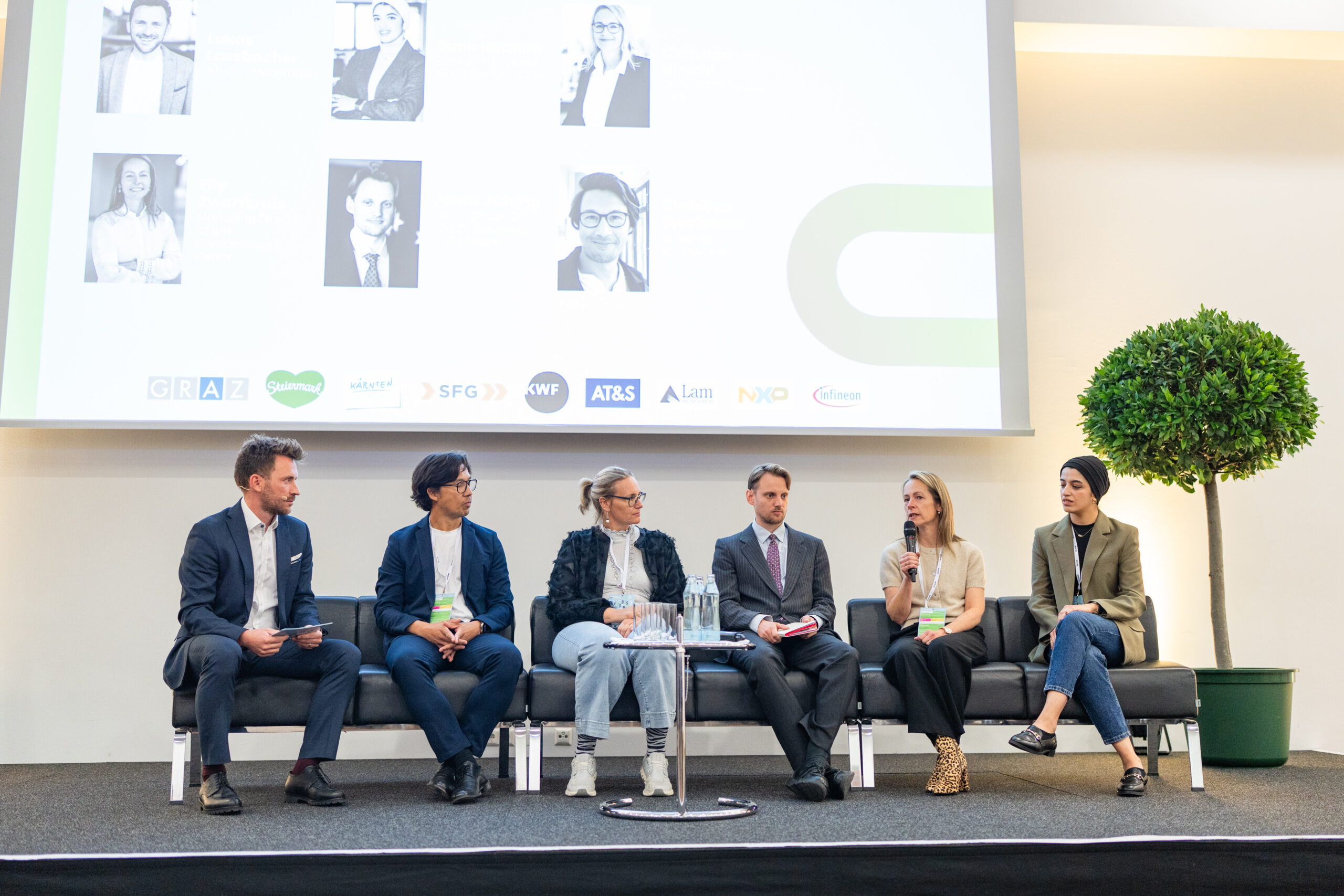
EBSCON 2026: ‘Crossroads – Europe at a Turning Point’ – a recap
Graz/Villach, 9 October 2026. Europe is at a turning point when it comes to semiconductors, AI and strategic technologies. EBSCON, the leading trade fair for the European semiconductor and electronics industry, held in Graz on 7 October 2026, was therefore themed ‘Crossroads – Europe at a Turning Point’.
More

10. September 2026
AT-C³ at FFG Forum 2026: Strengthening Austria’s Innovation and Technology Ecosystem
At the FFG Forum 2026 in Vienna, AT-C³ was represented by Lukas Lassbacher, who introduced the Austrian Chips Competence Center and represented its role within the European semiconductor and innovation ecosystem.
More

27. August 2026
Free Online Training Courses in the microelectronics field starting in October!
AT-C³ is officially launching its new training program in October 2026, offering free online courses for professionals, researchers, students and anyone interested in deepening their knowledge of microelectronics.
More
14. July 2026
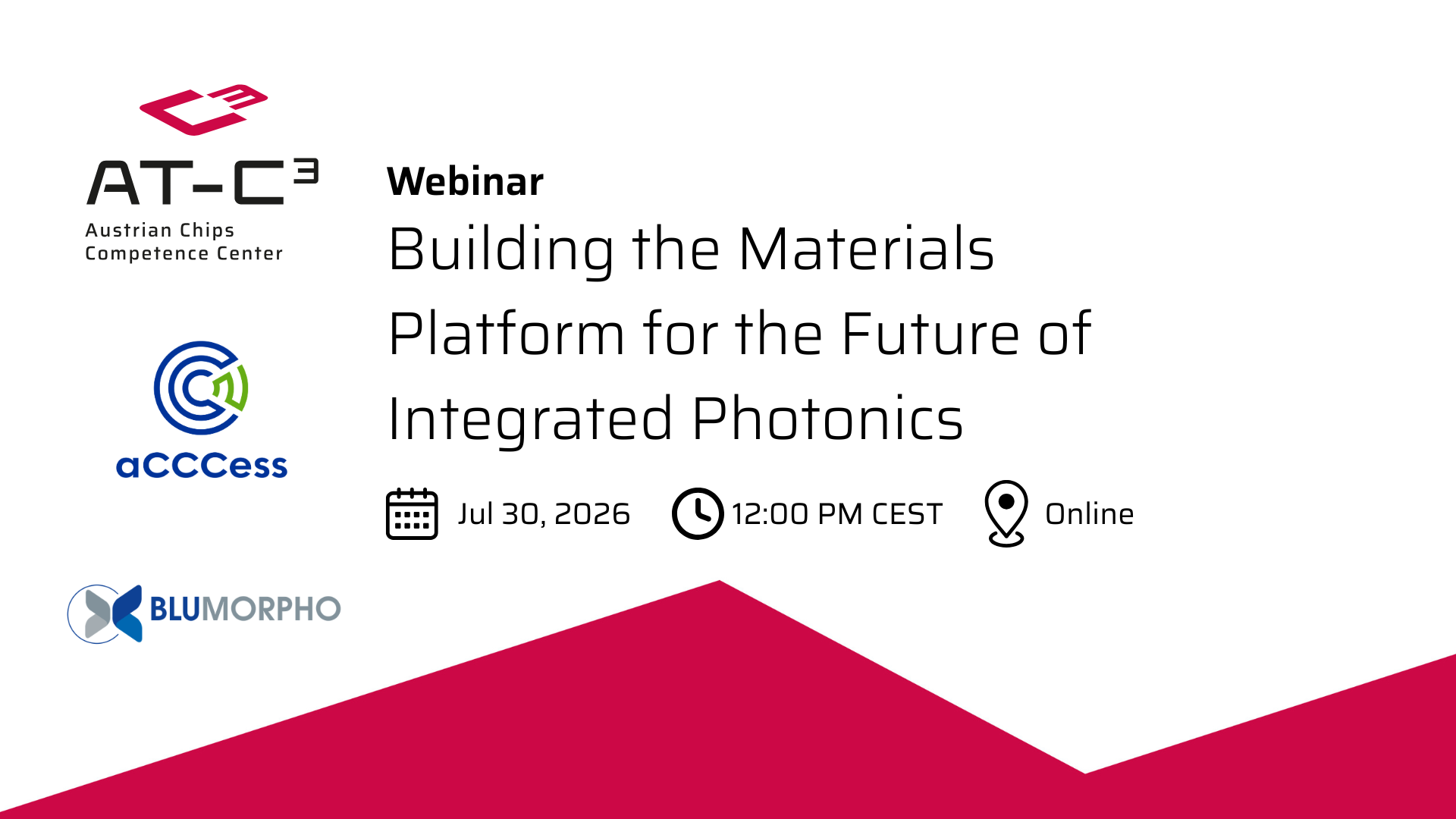
Webinar 30 July 2026: Building the Materials Platform for the Future of Integrated Photonics
In this Chips Think Tank webinar on July 30, 2026, Jean-Louis Guyaux, VP Technology at Riber, will share how one of Europe’s leading epitaxy equipment manufacturers is evolving from supplying MBE systems to enabling complete materials platforms for integrated photonics.
More
8. July 2026
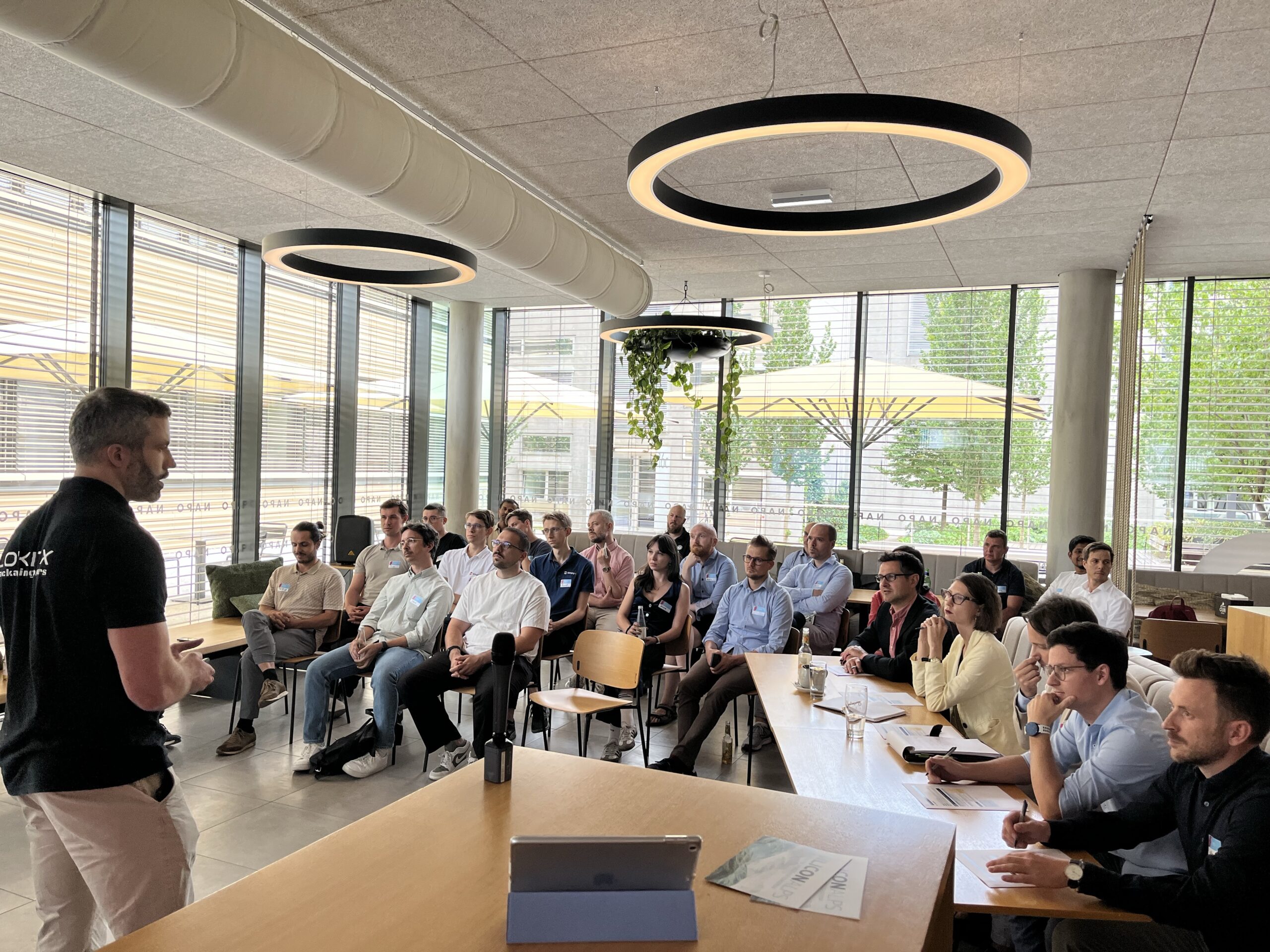
AT-C³ Joins the First Event of Intent to Foster Innovation & Startup Collaboration
AT-C³ was pleased to participate in the first Event of Intent at NAPO on the Campus Inffeld of the Graz University of Technology. The new networking format brought together around 40 participants from startups, scaleups and established companies with one clear goal: transforming conversations into concrete collaborations.
More

26. June 2026
ITF World 2026 – A Recap
More than 2,000 international technology and AI leaders gathered in Antwerp for IFT World, organized by imec under the theme “Strategic paths to an AI-Defined Future.”
More
17. June 2026
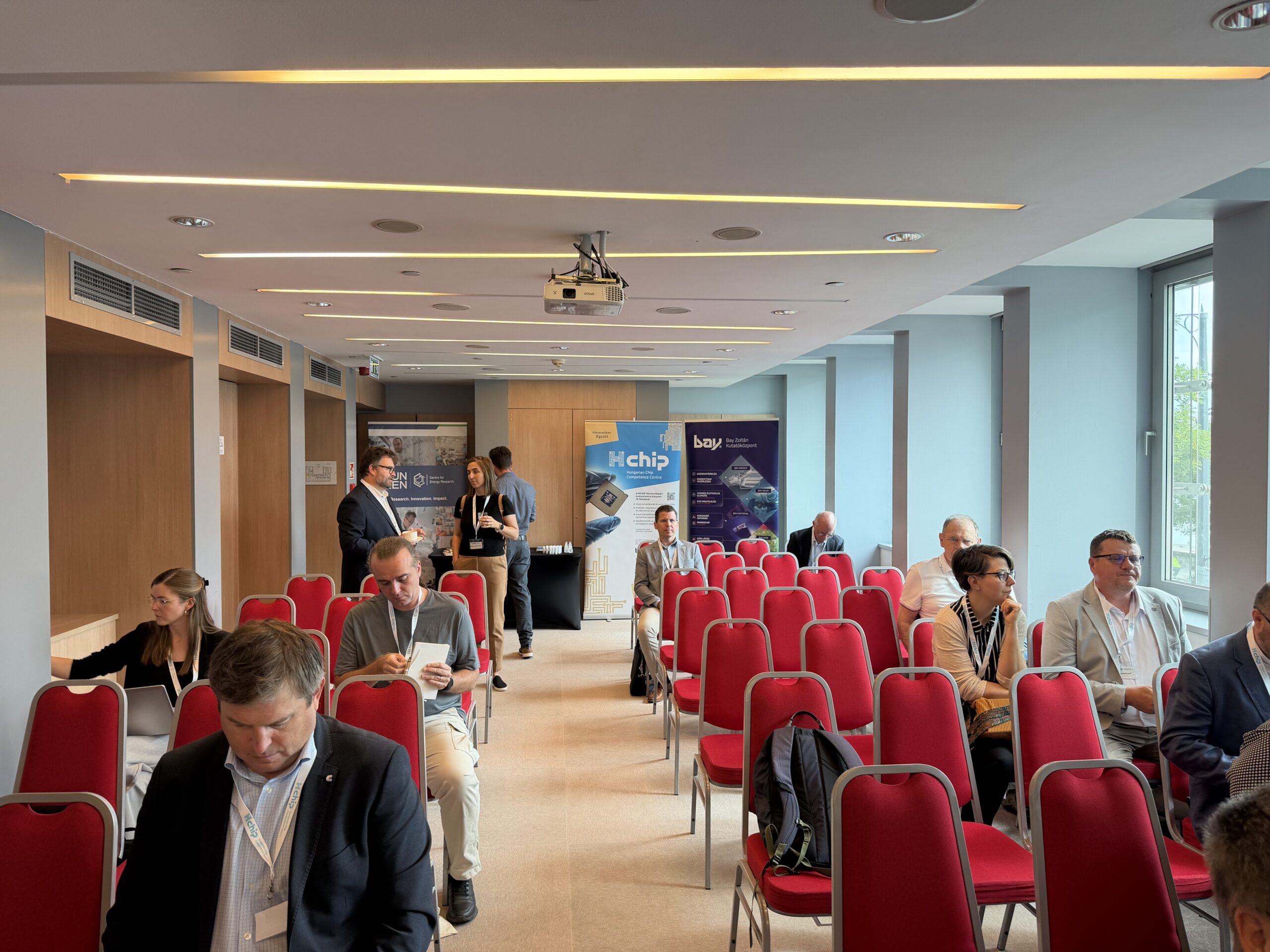
European Semiconductor Collaboration Days
On 4–5 June 2026, stakeholders from across the European semiconductor value chain gathered in Budapest for the European Semiconductor Collaboration Days 2026.
More
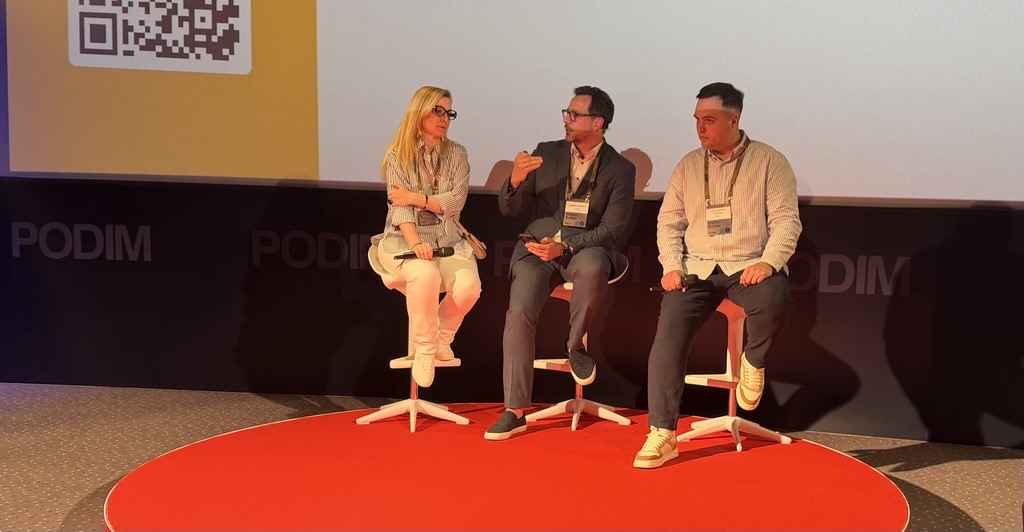
8. June 2026
PODIM 2026 – A Recap
PODIM 2026 ran from May 11–13, with May 11 as a pre-conference day and May 12 and 13 as the two main conference days. The “second day” of the event proper is May 12. Here’s a breakdown of what happened, and how Infineon was involved.
More

10. January 2026
This was EBSCON 2025
The leading trade fair for the European semiconductor and electronics industry on October 8, 2025, was for the first time part of EBSCON WEEK and focused thematically on “Creative Destruction.” As part of EBSCON 5.0, representatives of European Chips Competence Centres (CCC) signed the “Declaration of Graz” to strengthen Europe-wide collaboration.
More
Trends Ticker
All dates and events at a glance.
Kritische Codeausführung: GitLab veröffentlicht dringende Sicherheitsupdates
Mit Updates für mehrere Versionszweige schließt GitLab zwölf Sicherheitslücken, darunter auch eine kritische Lücke zur Remote-Codeausführung.
MoniRail secures share of £50 million Government investment in quantum tech – Rail UK
MoniRail secures share of £50 million Government investment in quantum tech – Company News
Was die PHP-Sicherheitslücke für das Internet bedeutet
Die PHP-Lücke: Notfall-Updates sind verfügbar, doch weltweit suchen Angreifer weiter nach ungeschützten Servern. Wann kann bei der PHP-Sicherheitslücke Entwarnung gegeben werden?
Chinese AI Tool ARTEX Can Breach Security in 15 Seconds, Test by Tokyo Cybersecurity Firm Reveals
Microsoft Uncovers AI-Driven Global Cyber Attack on ConnectWise by Chinese-Linked Hackers
A Chinese state-aligned hacking group has compromised IT services firm ConnectWise using an AI-driven penetration testing tool, targeting hundreds of – Get the latest breaking news and top stories from Sri Lanka, the latest political news, sports news, weather updates, exam results, business news, entertainment news, world news and much more from News 1st, Sri Lanka’s leading news network.
U.S. AI Security Posture Management Market 2026-2033: Rising Enterprise AI Risks Create New Cybersecurity Oppo
The U S AI Security Posture Management Market is gaining attention as organizations seek greater visibility and control over their expanding AI environments From generative AI assistants to machine learning models embedded in business applications enterprises are introducing new technologies …
IT-Experte zur Sicherheitslücke: „Schäden weltweit im zigfachen Millionenbereich“
Eine weltweite Cyber-Warnung sorgt auch in Deutschland für massive Störungen: Wegen gefährlicher Sicherheitslücken in der Web-Programmiersprache PHP habe…
Websites Down: What Is PHP And How Has It Raised AI Hacking Fears?
Artificial intelligence has found critical security flaws in a major programming language called PHP, with many websites taken offline Thursday as organisations worldwide scramble to fend off would-be hackers.
Post-Quanten-Kryptografie: Industrie muss jetzt handeln
(Bild: MTG) Quantencomputer bedrohen RSA/ECC in OT und Industrieanlagen. Warum Post-Quanten-Kryptografie und flexible Security heute nötig sind.
Niemand hat der SPS von Post-Quanten-Kryptografie erzählt
Post-Quanten-Kryptografie: Eine heute gekaufte Industriesteuerung könnte 2046 noch laufen. Ob sie sich nachrüsten lässt?
Post-Quantum Cryptography and Data Protection: Legal and Ethical Implications for Global Cybersecurity
What Is Q-Day? Post-Quantum Cryptography (PQC) Explained
Q-Day is the cybersecurity term for the moment quantum computers become powerful enough to break today’s main public key encryption systems, including RSA and elliptic curve cryptography (ECC). Nobody can put a date on it yet, but recent research suggests… The post What Is Q-Day? Post-Quantum Cryptography (PQC) Explained appeared first on Security Boulevard.
BitRipple and Eclypses Partner to Deliver Accelerated, Post-Quantum Resilient Data Protection for Challenging Networks
BERKELEY, Calif. & BOSTON–(BUSINESS WIRE)– #BitRipple–BitRipple and Eclypses partner to combine post-quantum data protection with accelerated, resilient transport for secure, reliable communications.
Siemens Software Center: Sicherheitslücke aktiv ausgenutzt
Achten Sie auf die Sicherheitslücke im Siemens Software Center: Schadsoftware wird aktiv über Version 3.5.8.7 verbreitet.
F.A.Z. Frühdenker: Rätselraten nach dem Hackerangriff auf die AfD
Ein neues Ticketsystem soll das Fahren mit Bus und Bahn smarter machen, im Netz kursieren Daten aus dem AfD-Hack, die EU will sich in der Arktis behaupten. Und in der Champions League treffen die Bayern und Leipzig auf Hochkaräter. Der F.A.Z. Frühdenker.
Accenture, Dragos launch $10M utility cybersecurity initiative
Are Systems Ready for Quantum-Resistant Cybersecurity?
Overview: Quantum computing could eventually threaten widely used public-key encryption methods, putting sensitive business data and digital communications at r
New cybersecurity challenges are on the horizon; will the world be ready?
A hacked robot assistant gathers intel to steal the identity of a senior in a care facility. A caller with a deepfake of a loved one’s voice begs a family member to pay a ransom to a “kidnapper.” A compromised car sensor prevents it from braking safely.Cybersecurity is a shifting landscape, and new technologies, for all their promise, can also threaten new nightmare scenarios.
Constella Intelligence and Aquila Deep Intel Announce Strategic Partnership to Advance Cyber Threat
The partnership combines Constella Intelligence’s extensive cyber intelligence data assets with Aquila Deep Intel’s regional expertise.
DORA: Was Finanzunternehmen bei Kryptografie und PKI nachweisen müssen
Bis Ende 2026 sollen alle EU-Mitgliedstaaten mit der Umstellung auf Post-Quanten-Kryptografie begonnen haben.
AI Learns to Spot Cyberattacks With Almost No Labeled Data
Researchers have developed a semi-supervised, domain-adaptive intrusion detection algorithm that combines mutual-information-maximizing adversarial networks with uncertainty-aware pseudo-labeling to
Machine Learning Shows Promise Against Campus Cyberattacks, But Evidence
A systematic review of 200 studies finds machine learning effective for detecting DDoS and ARP spoofing attacks on university networks, but warns that evaluation gaps and limited real-world testing
Aus für Phishing-SMS in Österreich: RTR schaltet „textbasierte“ SMS-Absenderkennungen frei ⋆ TOP News Österreich – Nachrichten aus Österreich und der ganzen Welt
Auf TOP News Österreich erfahren jetzt schnell und aktuelle alles was in Österreich und der Welt passiert – kurz und direkt!
The Quantum Security Transition: A Policy Agenda for Post-Quantum Readiness in Asia Pacific – EUROPE SAYS
Encryption is a quiet foundation of digital trust. It protects government services, financial transactions, critical infrastructure, healthcare records,
HSZ-BW: Cyberangriff legt Bewerbungsportale und Hochschulverwaltung lahm
Der Angriff vom 7. Oktober beeinträchtigt Verwaltungsdienste und Bewerbungen an mehreren Hochschulen; Umfang eines möglichen Datenabflusses wird untersucht.
Infineon and Wolfspeed hook up on SiC wafers
Infineon and Wolfspeed have signed a new multi-year supply agreement for 200mm SiC wafers to take over from 150 mm wafers “Silicon carbide is at the heart of the energy […] The post Infineon and Wolfspeed hook up on SiC wafers appeared first on Electronics Weekly.
The Low Voltage Direct Current (DC) Circuit Breaker Market Is Projected to Grow at a 6.4% CAGR Through 2030
The Business Research Company’s The Low Voltage Direct Current (DC) Circuit Breaker Market Is Projected to Grow at a 6.4% CAGR Through 2030
Pure Data Centres: Pure DC's LON01 campus completes installation of final power transformer
1,000-tonne capacity gantry system used to position the third and final transformer, completing LON01’s power infrastructureLondon, Oct. 15, 2026 (GLOBE NEWSWIRE) — Pure Data Centres Group (Pure DC),
Microchip adds radiation-tolerant GaN point-of-load converter to space power portfolio
Power device delivers 20A of continuous current in compact form factor
Global Converter Supply for Automotive Electronics: Why CONEVO Is a Partner Manufacturers Trust
During a hot-weather endurance test, an onboard charger module has to hold its output steady while the input voltage swings and the under-hood temperature
U.S. Government Selects Navitas to Develop Next-Generation 10 kV SiC Power Semiconductors
U.S. Government Selects Navitas to Develop Next-Generation 10 kV SiC Power Semiconductors () | aktiencheck.de
Taiwan power chipmakers see firmer prices through 2027 15:02AI server power needs drive demand for MOSFETs and protection devices #news #taiwan
India’s chip push gathers pace: 25 SEMICON deals target gases, chemicals, packaging and power electronics
Nearly 12,000 visitors attended the opening day of the New Delhi event, showcasing has more than 600 exhibitors – including international participants from Japan, Singapore, South Korea, and Europe joining India’s semiconductor outreach.
Chinese Gallium Oxide Breakthrough
A Post-Silicon Materials Advance and Its Thermoeconomic Implications
AI Power Demands Push GaN into Data Center Design
Rising AI power demands are pushing data center designers toward GaN-based power conversion for higher efficiency and density. The post AI Power Demands Push GaN into Data Center Design appeared first on EE Times.
ABB’s new direct current portfolio aims to rewire AI data center energy infrastructure
ABB today announced the launch of Infinitus, a portfolio of direct current (DC) solutions designed to manage the increasing power demands of AI data centers. The portfolio will accelerate the adoption of DC architectures in data centers, improving energy efficiency and reducing power infrastructure footprint, while increasing available computing capacity. ABB expects other energy-intensive industries to make the same transition.
Chasing the 1%: Power Electronics and the Modern Grid Ecosystem
We invite power electronics professionals to scan this eBook to gain insights into the cutting-edge developments around grid modernization and energy infrastructure. The post Chasing the 1%: Power Electronics and the Modern Grid Ecosystem appeared first on Power Electronics News.
From Supercapacitors to Lithium-ion Capacitors: State-transition-aware energy management in energy harvesting systems
Publication date: 30 December 2026Source: Journal of Energy Storage, Volume 182, Part BAuthor(s): Nagham El Ghossein, Moustafa Hammoud
Marel Power Solutions Secures $1.9M to Scale Power Electronics Manufacturing
Marel Power Solutions, Inc. announced that it has been awarded $1.9 million through the Michigan Supplier Conversion Grant Program, administered by the Michigan Department of Labor and Economic Opportunity (LEO).
New Solar Film Could Power Electronic Devices with Indoor Light
Small solar cells have powered calculators for decades, but similar technology may eventually run a much wider range of electronic devices using only the light available indoors. Researchers at Penn State have improved a thin solar material so that it can capture indoor light more effectively and maintain its performance over time. The advance could […]
Rohm’s SiC chips support BMW’s electric powertrain architecture
The high-performance components integrated into the vehicle support key power electronics functions and are designed to deliver high energy efficiency as well as reliable operation under demanding automotive conditions.
INFAC: Integrierte 48-V-DC/DC-Wandlung – AEEmobility
Durch die batterieintegrierte Spannungswandlung soll sich die Zahl externer Hochvolt-Schnittstellen verringern. Dies kann Kabelwege, Bauraum und Komponentenaufwand reduzieren und erleichtert die Umsetzung modularer 48-V-Zonenarchitekturen.
Top DC Circuit Breaker Manufacturer Advances Solar Electrical Protection Solutions
As the global deployment of solar photovoltaic systems and other DC-powered applications continues to expand, electrical protection components have become
Nexperia and Tata Electronics partner to produce MOSFETs in India
The deal covers wafer manufacturing at Dholera and assembly and test at Jagiroad, part of Tata Electronics’ $14 billion investment.
ABB’s new direct current portfolio aims to rewire AI data center energy infrastructure
Power Electronics Market Size is Expected to Reach USD 53.1 Billion by 2034 | CAGR: 4.87%
Power Electronics Industry Size IMARC Group a leading global market research and management consulting firm has published its latest market intelligence report on the power electronics market The global power electronics market size reached USD 34 6 Billion in 2025 …
Renewable Energy Expansion Reshapes the Power Transformer Market in 2026
The global power transformer market was valued at USD 27.0 billion in 2025 and is projected to increase from USD 28.7 billion in 2026 to USD 45.8 billion by 203
Enhanced harmonic compensation control in a bidirectional single-stage resonant PFC circuit for electric vehicle chargers
Robust model-free DC-bus voltage regulation for stand-alone solar-powered electric vehicle charging stations with experimental laboratory verification
This paper proposed an ultra-local model free control (ULM) strategy for robust DC bus voltage regulation in a stand-alone solar powered electric vehicle charging station. In this study, the system under consideration consists of a photovoltaic (PV) generator interfaced via a maximum power point tracking (MPPT) controlled boost converter, a battery energy storage system (BESS) connected through a bidirectional buck-boost converter, and a shared DC-bus supplying a DC load that emulates Electric Vehicle (EV) charging behavior without grid support. In general, the proposed control strategy is intended for DC bus voltage regulation and real-time power balancing in highly uncertain operating conditions without considering the accurate parameters of the converter and battery, which might have occurred due to temperature changes and component aging. Unlike conventional PI/PID control schemes, the proposed ULM does not require an accurate model of the system since it can estimate the system’s behavior with the help of its ultra-local representation. This approach is experimentally verified on the laboratory scale prototype implemented on the dSPACE 1104 real-time platform. The test results under rapid irradiance changes, large load steps, and inductance mismatches verify the effectiveness of the proposed ULM in achieving better performance compared to the well-tuned PID controller in terms of reduced voltage deviation by 35%, approximately 4 to 5 times faster recovery response, zero overshoot, and reduced control efforts. This verifies the effectiveness of ULM as a viable approach for reliable off grid solar powered EV charging infrastructure and the proposed DC-microgrid (DCMG).
GAN-Augmented Comparative Machine Learning for Microhardness Prediction in SLM-Fabricated Ti-6Al-4V with XAI-Driven Sensitivity Analysis
Publication date: Available online 19 September 2026Source: Materials Today CommunicationsAuthor(s): Nihal YUMAK
Photonic Integrated Circuit (PIC) – Global Strategic Business Report: Capitalize on 19.7% CAGR to US$5.5 Billion by 2030 as Broadcom, Intel, Ciena, Infinera and Acacia Reshape the Market
Capitalize on rising demand for high-bandwidth, energy-efficient PICs across telecom, data centers, biosensing and lidar, with insights into tariffs,…
We are proud to announce that ams OSRAM’s Imaging-to-Display Sensing Solution has been adopted in vivo X500 Pro Max. Bringing together behind-OLED spectral sensing, multi-zone dToF depth sensing, and ambient spectrum and flicker detection, the solution supports a more natural and comfortable display, faster and more precise autofocus, and more stable, true-to-life image capture. This collaboration combines vivo’s expertise in mobile imaging, display, and device optimization with ams OSRAM’s leadership in advanced optical sensing. Together, we are transforming precision sensing at the component level into a flagship visual experience that users can see and feel. Learn more about how sensing is helping smartphones better understand light, color, and space. #amsOSRAMMobileWearables #sensors #mobileinnovation #mobiledisplay
STMicroelectronics reveals high-accuracy two-in-one altitude and underwater depth sensor for wearables and sports cameras
STMicroelectronics has combined altitude and underwater-depth monitoring over 50 meters in a single MEMS sensor that saves space, simplifies circuitry,…
Startschuss für digitale Drucktechnologien 🚀 Am 30. September 2026 haben wir am Lehrstuhl für Chemie der Kunststoffe an der Montanuniversität Leoben das Zentrum für digitale Drucktechnologien offiziell eröffnet – mit Gästen aus Forschung, Industrie und Öffentlichkeit. Lab-Touren, Live-Demos und Keynotes boten tiefe Einblicke in leitfähige Tinten, Sensorik und flexible Elektronik. Möglich gemacht durch eine Infrastrukturförderung von 1,5 Mio. Euro durch das Bundesministerium für Frauen, Wissenschaft und Forschung ( 1.084. 000 €) und die Montanuniversität Leoben (500.000 €), ist das Labor seit Frühjahr 2026 mit modernen Druckern und Verfahren ausgestattet – für die Erforschung, Entwicklung und Qualifizierung gedruckter elektronischer Bauelemente. Jetzt wurde es offiziell eröffnet. Danke an Thomas Grießer (Leiter des Lehrstuhls), Rektor Peter Moser, Alice Lassnig (Leiterin des Zentrums für Digitale Drucktechnologien und Arbeitsgruppenleiterin der Gruppe für Gedruckte Elektronik), Boris Buchroithner und Krzysztof Krawczyk, für Grußworte, Einordnung und Keynotes – und an alle Gäste für den intensiven Austausch beim Networking. #PrintedElectronics #AdditiveManufacturing #Digitaldruck #MaterialsScience #MontanuniversitätLeoben #Innovation #Sensorik #FlexibleElektronik #BMFWF #Kooperationen #Forschung
TDK stellt mit PositionSense™ Sensorlösungen für Wearables, Mobilgeräte, Roboter und weitere KI-gestützte Geräte vor
How can motion sensors become smarter while consuming less power and fewer resources? 📡 STMicroelectronics has introduced new 6 axis IMUs that combine motion sensing with embedded intelligence and a stronger focus on sustainability. The devices target applications including wearables, smart devices, industrial systems, and IoT products, helping developers process more sensor data locally while reducing power consumption.
Ernten verlässlich planen, Schneehöhen aus der Ferne vermessen, Kohlenstoff im Wald präzise erfassen: Im Klagenfurter Lakeside Park machen Unternehmen wie Avemoy, VUM und das E.C.O. Institut für Ökologie aus Sensordaten Entscheidungsgrundlagen für Landwirtschaft, Energiewirtschaft und Naturschutz. Den Weg in die Praxis ebnet die Nähe zu Forschung, Testinfrastruktur und Kapitalgebern direkt neben der Universität Klagenfurt. Mit seinem Standortmarketing macht das Land Kärnten diese Stärken national und international sichtbar, denn der Großteil der Wertschöpfung entsteht hier außerhalb des Tourismus. Den Link zum gesamten Beitrag finden Sie in den Kommentaren. Dieser Beitrag wurde mit finanzieller Unterstützung vom Amt der Kärntner Landesregierung ermöglicht.
Cross-Modal Sensor Data Segmentation Using Foot Pressure and Inertial Signals
When extracting features for activity recognition, applying a fixed-length sliding window without considering activity transition timing may result in multiple activities being included within a single window, potentially degrading recognition performance. To address this issue, we propose an activity segmentation framework centered on a foot-pressure-based segmentation method (FP). The framework further incorporates multiple segmentation strategies by combining the proposed foot-pressure-based method with a conventional spectral transition measure-based method (STM), and investigates their effects on subsequent activity recognition. Experimental results show that the FP and STM methods exhibit different activity-boundary detection characteristics. FP achieves higher precision, whereas STM provides higher recall, and combining the two methods increases boundary coverage. Activity recognition experiments further show that the effect of segmentation depends on the evaluation setting, and that adding foot-pressure features to the recognition model does not consistently improve recognition performance. These results demonstrate the potential of foot-pressure signals to provide boundary information that differs from inertial sensing and highlight the importance of evaluating their role in activity segmentation rather than simply treating foot-pressure data as additional recognition features.
The Silicon Photonics Foundry Layer: Who Can Actually Make a PIC
$TSEM $GFS $TSM $STM $UMC $SOI | Who fabricates the PIC, and why the bottleneck comes after the wafer
Camera manufacturers continuously strive to improve image quality, yet automatic white balancing (AWB) still struggles in challenging scenes and lighting conditions, often resulting in unnatural colors and inaccurate skin tones. A new generation of chip-scale multi-channel XYZ spectral sensors address this challenge by identifying the spectral signature of ambient light rather than estimating it from image content alone. The result is more accurate light source detection, improved color constancy, and true-to-life imaging across smartphones, smart glasses, and action cameras. Read more in our blog about: 🔹How spectral sensing solves true-to-life camera color constancy in challenging lighting conditions: 🔹Spectral sensors for automatic white balancing (AWB) enhance color consistency : https://lnkd.in/gwgus7Qx 🔹Download the white paper: https://lnkd.in/gsdvTAjS #SpectralSensing #ColorConstancy #MobileInnovation #TrueColor #amsOSRAMMobileWearables
Organ-on-a-chip technology approaches replacing animal testing
Archyde Non-animal methods, or NAMs such as organs-on-chips and computational simulations, are approaching technological readiness to replace animal testing in drug development. Despite shifting regulatory backing from the FDA and NIH, … Read More The post Organ-on-a-chip technology approaches replacing animal testing appeared first on Archyde.
Momentus Demonstrates AI-Enabled LiDAR and Imaging Suite During Successful On-Orbit RPO Mission with NASA Satellite
SAN JOSE, Calif.–(BUSINESS WIRE)–Momentus Inc. (NASDAQ: MNTS) (“Momentus” or the “Company”), a U.S. commercial space company specializing in satellite technology, space transportation, and in-orbit services, today announced the successful completion of a Rendezvous and Proximity Operations (RPO) demonstration by its Vigoride-7 Orbital Service Vehicle (OSV) utilizing low-cost commercial components for its sensor suite in a mission with a NASA satellite. The RPO demonstration showcased the Compa
New Wearable Sensor Can Detect Touch Without a Battery
Imagine a wearable sensor that feels a tap, uses the energy from that tap to power itself and briefly “remembers” what happened. Researchers in South Korea have built an experimental device that brings those functions together in a flexible piece of electronics. The device takes inspiration from the way the body senses touch. When your […]
Biosensors for Point-of-Care Diagnostics Market Insights, Competitive Landscape, and Forecast – 2033 | Connected Wearables and Home-Based Testing Unlock $27.6 Billion by 2033
Growth opportunities center on wearable and multiplexed biosensors, digital health integration, telemedicine, strategic partnerships, product innovation and regional expansion Growth opportunities center on wearable and multiplexed biosensors, digital health integration, telemedicine, strategic partnerships, product innovation and regional expansion
Hybrid Photonic Integrated Circuit Market Size, Share, Growth, and Forecast, 2026-2035 | AI, 5G, and Data Center Demand to Drive 13.6% CAGR and US$6.82 Billion Global Market
Capitalize on data centers, 5G, LiDAR and quantum photonics through silicon photonics innovation, operational efficiency and strategic partnerships Capitalize on data centers, 5G, LiDAR and quantum photonics through silicon photonics innovation, operational efficiency and strategic partnerships
Silicon photonics and InP photonic integrated circuit market to grow to $48bn by 2036
Acceleration of silicon photonics adoption requires simpler, externally modulated CW lasers
Calterah Turns UWB Digital Keys into In-Cabin Sensors
Calterah brings UWB keyless anchors into synchronized networks, delivering enhanced vehicle safety without adding expensive hardware. The post Calterah Turns UWB Digital Keys into In-Cabin Sensors appeared first on EE Times.
Infineon XENSIV™ TLx49012 Winkelsensoren ermöglichen Motorsteuerung-Selbstkalibrierung in Automotive- und Industrieanwendungen
Global Autonomous Systems and Vehicles Market Report 2027-2037 | Robotaxis, Autonomous Trucking, AI, Lidar, and eVTOL Unlock New Revenue Opportunities
Commercial momentum builds through robotaxi scale-up, corridor-based freight, strategic partnerships, sensor cost compression and cross-domain expansion. Commercial momentum builds through robotaxi scale-up, corridor-based freight, strategic partnerships, sensor cost compression and cross-domain expansion.
How can a humanoid robot see reliably when lighting conditions change? A robot working alongside people cannot depend on ideal illumination. It may need to operate in low light, distinguish subtle details or recognize materials that look like the human eye. Infrared emitters provide active illumination for low-light imaging. Ambient light and spectral sensors help the vision system understand its optical environment. Active spectroscopy and photodetectors can go further, enabling application-specific analysis of the spectral signature of materials. For robot manufacturers, this means designing perception systems that are not limited to what human vision can detect. See how ams OSRAM optical technologies support perception in human-centered environments: #amsOSRAM #HumanoidRobots #Robotics #DigitalPhotonics #OpticalSensing #infraredLED
What a remarkable week for ams OSRAM in Michigan for the automotive industry! From engaging with industry leaders at SID Vehicle Displays and Interfaces Conference, to hosting our Automotive Interior Lighting and Sensor Technology Seminar and bringing professionals together through our Women in Automotive Lighting Leadership (WALL)networking event. Every conversation reinforced a common vision: creating smarter, safer, and more human-centric mobility experiences. A sincere thank you to everyone who joined us, shared insights, and contributed to the discussions. Together, we're shaping the next generation of intelligent in-cabin experiences and automotive innovation. #amsOSRAM #AutomotiveLighting #InCabinSensing #AutomotiveTechnology #SmartVehicles #DisplayTechnology
Was treibt Forscherinnen und Forscher an? 🔎Michael Somma im APA Science Interview 👨🔬 Unser #Nachwuchsforscher Michael Somma vom Institut DIGITAL wurde von APA Science porträtiert. 🎓️ Der 32-jährige Doktorand beschäftigt sich mit einer hochaktuellen Frage: Wie kann künstliche Intelligenz dazu beitragen, kritische Infrastruktur wie unsere Wasserversorgung vor Cyberangriffen zu schützen❓️ 💥 Dabei verbindet er komplexe Systemtheorie mit KI-Methoden. Ziel sind Modelle, die Abweichungen in #Sensordaten erkennen, gleichzeitig aber weniger rechenintensiv und besser nachvollziehbar sind – ein wichtiger Punkt, wenn KI in sicherheitskritischen Bereichen eingesetzt wird. 🔛 Er arbeitet am theoretischen Modell bis zur konkreten #Anwendung in der Praxis. 🙋♂️ Michael Somma: „Ich habe in mich reingespürt und festgestellt, dass ich ein Forschertyp bin. Ein ehemaliger Uniprofessor hat mich dabei inspiriert. Er hat oft gesagt, dass es 2 Arten von Menschen gibt: Die einen sind angetrieben von Dingen, die sie wissen, die anderen von Dingen, die sie nicht wissen. Ich zähle mich klar zur zweiten Gruppe.“ Quelle: Interview mit APA Science 👉 Das ganze Porträt bei APA Science nachlesen: „Angetrieben von Unbekanntem“ JOANNEUM RESEARCH DIGITAL #JOANNEUMRESEARCH
PPI 2026 – Thank you for four inspiring days in Leoben ✨ From September 1–4, 2026, “PPI 2026 – Polymer Process Innovation” gathered experts from 9 countries ? at Montanuniversität Leoben. The programme featured 1 plenary lecture, 7 keynotes, 35 talks, 13 posters, and 1 panel discussion. Highlights: Sustainable Polymers ♻️: circular economy, recycling, LCA, bio-based/biodegradable materials Smart Polymers🧠: function integration, sensors, functional surfaces, hybrid processes Digital Polymer Science💻: ML, simulation/digital twins, real-time control, AI-driven QA Get the Book of Abstract here A big thank-you to all authors, reviewers, session chairs, the Scientific & Organising Committees, our hosts at@ Montanuniversität Leoben, and our partners and sponsors. Your support made PPI 2026 possible! #PPI2026 #PolymerEngineering #Innovation #SustainablePolymers #SmartPolymers #DigitalTwin #AI #Leoben #Montanuniversitaet #Conference
🛰️ Fieldwork for tomorrow's robots 🤖: out and about with a LiDAR backpack🎒 and 360° camera. 🥾 How do autonomous robots learn to navigate safely❓️ 🔑 Autonomous outdoor robot navigation is considered a key technology for Europe's digital and sustainable future – and it's especially challenging in🍇 viticulture: robots need to navigate predefined paths through vineyards, even as conditions constantly change due to growth cycles, seasonal variation, and shifting ground conditions. 🌿🍂 Over the past months, the #DigitalTwin Lab team at JOANNEUM RESEARCH DIGITAL has been out in the field with a backpack-mounted LiDAR system and a 360° camera as part of the 𝐒𝐄𝐀𝐒𝐎𝐍-𝐓𝐰𝐢𝐧 project – across multiple seasons, to capture how the environment changes over the course of the year. 🌱🍂❄️ 🔛 The key question: how can these 3D scans be turned into a #DigitalTwin that captures the spatial layout as well as seasonal changes of real outdoor environments accurately enough for autonomous robots to learn to navigate safely within it❓️ From the collected point clouds, the team carried out semantic information recovery — segmenting, classifying, and annotating the environment. One direct result: a cost map for #RobotNavigation, which will form the basis for safe and efficient path planning in the digital twin going forward. 🗺️🤖 ▶️ The animation shows how the captured environment changes across the seasons – a key building block for realistic, dynamic simulation scenarios, which will increasingly be generated using generative AI and procedural 3D modeling. More on the simulation methodology and on uncertainty modeling for improved context-awareness in robot navigation coming soon from JOANNEUM RESEARCH ROBOTICS – stay tuned! 🔜 With Sebastian Wurm and Benjamin Breiling 💥 More about the project: #LiDAR #Robotics #AI #Research #Innovation #3DReconstruction #AutonomousSystems
What if your alarm clock could do a lot more than just wake you up? ⏰ Our partner Seekwon turned that idea into reality with ClookC, a smart clock powered by Infineon's XENSIV™ 60 GHz radar sensor. ✨ No wearables required 💤 Contactless sleep, respiration, and heart rate tracking 🙋 Wave your hand to snooze or stop the alarm 🔒 Privacy-friendly AI processing directly on the device And because technology should be fun, ClookC combines smart health features with an engaging, interactive user experience. A great example of how radar technology is transforming everyday devices into smarter, more intuitive companions. Your alarm clock might soon become your favorite health gadget. 😍 Read more here: 🔎
Apple Pay Launches in India with Axis Bank Cards, Expands Contactless Payment Options – Elets BFSI
Apple Pay launches in India with support for eligible Axis Bank Visa and Mastercard credit cards, enabling contactless payments across iPhone and Apple Watch.
SteelSeries stellt Sensei Pro und Rival Pro mit UWB und 8.000-Hz-Abtastrate vor – Gamers.at
SteelSeries bringt vier Sensei-Pro- und Rival-Pro-Mäuse mit UWB-Funk, 8.000-Hz-Polling und wechselbaren Akkus ab 13. Oktober in den Handel.
Onomondo raises €100M+ to scale its global IoT infrastructure
The Copenhagen IoT infrastructure company will use the investment to expand internationally and develop its platform, with existing backer EIFO increasing its investment.
NTT DOCOMO BUSINESS and stc group launch IoT connectivity solution for Komatsu construction equipment in Saudi Arabia | IoT Now News & Reports
NTT DOCOMO BUSINESS and stc group have launched in-country IoT connectivity for Komatsu construction equipment in Saudi Arabia, meeting local roaming rules.
Touch 'n Go to add 10 more Enhanced RFID aisles by the end of 2026
KUALA LUMPUR: Touch ‘n Go Sdn Bhd (Touch ‘n Go) will add 10 more Enhanced RFID lanes by the end of this year to support the Multi-Lane Free Flow (MLFF) toll collection ecosystem.
Aspirity to buy majority stake in Danish IoT company Onomondo
London-based private equity firm Aspirity Partners has agreed to buy a majority stake in Onomondo, a Copenhagen firm that runs its own network to connect machines and sensors. The…
SteelSeries Sensei Pro and Rival Pro: UWB wireless mice with true 8K resolution and hot-swappable batteries
SteelSeries introduces Sensei Pro and Rival Pro, the new wireless mice with UWB, true 8K polling rate, hot-swappable batteries and a TrueMove 42K sensor.
EU introduces digital wallet: What citizens will be able to have on their phones by the end of the year – Business and Finance
By the end of 2026, every EU member state should offer a European digital identity, which will allow citizens to store documents, prove their identity, and use numerous services – with the ability to share only the data that is necessary.
CCAvenue brings Apple Pay to its merchant network, expanding contactless payment options
CCAvenue, the flagship payments brand of AvenuesAI Limited, has brought Apple Pay to its merchant network, expanding the payment options for customers using Apple devices.
New, no waste RFID label printer
Automatic RFID setup and first-label accuracy help reduce label waste, setup time and production interruptions…
BWSSB to install IoT devices in 6,000 borewells by March 2027
Bengaluru groundwater: BWSSB to install IoT devices in six thousand borewells by March twenty twenty seven to track real time water levels, prevent pump failures and improve water management across the city.
The first wireless energy transfer test between two spacecraft will soon be conducted in Earth orbit.
Star Catcher plans to conduct the first in-orbit wireless power transfer test between two independent spacecraft in October 2026 with the Protostar spacecraft.
Colombia | Nequi turns your phone into a card reader: businesses can now accept card payments via NFC | DPL News
Businesses, entrepreneurs, and freelancers using Nequi Negocios can now receive debit and credit card payments directly from a mobile phone.
Netmore and Itron complete validation of LoRaWAN Relay for smart water metering | IoT Now News & Reports
Netmore and Itron have validated LoRaWAN Relay across a smart water metering stack, extending AMI coverage to hard-to-reach meters without extra gateways.
Internet of Things (IoT) Precision Agriculture Sensors Market Report Offers Analysis of Market Development and
The Internet of Things IoT is revolutionizing agriculture by enabling precise monitoring and management of farming activities Precision agriculture sensors equipped with IoT technologies are transforming traditional farming practices helping farmers optimize resources increase yields and promote sustainability Let s …
Particle M635e Achieves Skylo Certification For Satellite IoT Connectivity
Particle by Digi, a division of Digi International, today announced that Particle M635e has achieved Skylo certification, giving IoT developers and enterprises a validated path to extend connected IoT solutions beyond the reach of terrestrial cellular networks.
I stopped using Wi-Fi smart plugs after switching to Zigbee relays, and my automations never fail anymore
I was fed up of my devices going offline.
Research on Internet of Things Data Management Market Indicates Growth to $128.8 Billion by 2030
The Internet of Things IoT data management sector has been experiencing significant growth recently driven by the rapid expansion of connected devices and the increasing complexity of data generated As industries and consumers increasingly rely on IoT technologies the management …
Resonant Link Medical Launches Next-Generation Vivigo™, the Industry's Most Advanced Wireless Power Platform for Implantable Medical Devices
/PRNewswire-PRWeb/ — Resonant Link Medical, an innovative medical technology company redefining wireless power and data transfer for implantable devices,…
Smart Cities Market Size, Share & Trends to Reach US$ 2,261.0 Billion by 2033 as IoT and Connected Infrastruct
According to DataM Intelligence the global smart cities market size was valued at US 699 7 billion in 2025 and is projected to reach US 2 261 0 billion by 2033 registering a CAGR of 15 6 during the forecast …
PlayStation Controller Could Soon Support Contactless Game Payments, Sony Patent Reveals
Sony has patented a PlayStation controller with contactless payment support. The feature could let users make payments directly through the gamepad.
5G IoT Market Size Set to Reach USD 356.44 Billion by 2035 | As Private 5G, Industrial IoT, RedCap and Connect
According to DataM Intelligence The 5G IoT Market was valued at US 13 32 billion in 2025 and is projected to reach US 356 44 billion by 2035 expanding at a CAGR of 39 1 during 2026 2035 The growth …
International Conference on Big data, Machine Learning and IOT (ICBMI)
International Conference on Big data, Machine Learning and IOT(ICBMI) will be held on 23rd-24th Oct 2026 at Taichung,Taiwan.It is a worldwide conference where many people gather from different place to discuss about particular topics so the creation of ideas December be bigger than we are thinking. so, Don’t miss the opportunity to establish yourself. It is the great place to re-innovate yourself and to make proud of yourself. The aim of the conference is to create solutions in different ways and to share innovative ideas. We are going to conduct on different fields like Engineering, Science and Management. Conference is going to be conducted on Taichung,Taiwan to bring out participants from stress and to make conference more rememberable. There will Awards ceremony for best performers and every participants will get a certificate and for each group, WCSET conference proceeding book and conference proceeding CD will be provided. We will provide food for Coffee break and Lunch break. The meeting will be held each year to make it a perfect stage for individuals to share perspectives and puts a spotlight on Science, Engineering, and Technology.
"No need to replace everything": RATOC Systems' retrofit IoT that utilizes existing equipment
Japanese sake is gaining popularity worldwide. In 2024, “traditional sake brewing” was registered as a UNESCO Intangible Cultural Heritage, and demand is increasing even further. However, sake brewing involves a highly difficult process called “first koji, second moto, third brewing,” which requires precise adjustments of temperature and moisture content down to the second and millimeter. RATOC Systems is supporting this process with IoT technology.
Sony Files Patent for PlayStation Controller That Can Accept Contactless Payments to Buy Games
Sony has filed a patent for a PlayStation controller that comes with the capability to read payment method information from credit cards or phones. The controller would communicate with cards or phones via NFC or Bluetooth. According to the patent, the controller will be able to read payment information and transmit it to the paired console to purchase games.


Submit your project idea now and shape the future.
Use our submission form to bring your innovation to AT-C³ – we’ll support you from concept to realization.